If you have ever bought a peptide vial and wondered why the label says “for research use only” instead of listing a dose, this is the article for you. It explains what these compounds are, how they are made and shipped, and what that disclaimer actually means in practice.
What a peptide actually is
A peptide is a short chain of amino acids — conventionally anything from two to about fifty residues. Below that range you have small molecules; above it you are into proteins. Insulin, with 51 residues, sits right at the boundary. Glucagon-like peptide-1 (GLP-1) is 30 residues. BPC-157 is 15. GHK-Cu is three.
That size is what makes peptides interesting to researchers: they are big enough to be highly specific — a peptide can bind one receptor and largely ignore its close relatives — but small enough to be synthesised chemically, purified by chromatography and characterised by mass spectrometry. You can know, with a reasonable degree of certainty, exactly what is in the vial.
Three families you will meet most often
- Incretin receptor agonists (GLP-1, GIP, glucagon). The metabolic line: retatrutide and tirzepatide fall here. They are the most studied peptides in the world right now, and the most imitated.
- Growth-hormone secretagogues. CJC-1295 and ipamorelin, usually supplied as a blend. Research interest centres on pulsatile GH release rather than continuous exposure.
- Repair and structural peptides. BPC-157, TB-500 (a thymosin β4 fragment), GHK-Cu. These work on tissue-level processes — angiogenesis, cell migration, collagen deposition — and are studied in tendon, skin and gut models.
A fourth group, mitochondrial peptides such as SS-31, is smaller but growing fast: SS-31 binds cardiolipin on the inner mitochondrial membrane, and a related formulation has received FDA approval for a rare genetic disorder.
Why it arrives as a powder
Almost every research peptide ships as a lyophilised powder — a freeze-dried cake in a sealed vial. Water is the enemy of peptide stability: it enables hydrolysis, deamidation and aggregation. Remove it and the molecule can sit at ambient temperature for the length of a shipment without measurable loss.
That is why a kit can travel from a factory in China to a lab in Ohio in four days with nothing but a desiccant sachet. It is also why the vial you receive contains a white or off-white plug rather than a liquid — and why a vial that arrives as a melted puddle, or with visibly discoloured powder, should be rejected.
What “for research use only” means
The phrase is not marketing shorthand. It marks a compound as a laboratory reference material: not approved as a drug, not evaluated for safety or efficacy in humans, and not intended for diagnostic, therapeutic or veterinary use. It also means the supplier is not giving you dosing, administration or medical guidance — and should not.
In practice, three things follow from that:
- No dosing information. A supplier who prints a dosage protocol on a research vial is telling you they do not understand their own regulatory position.
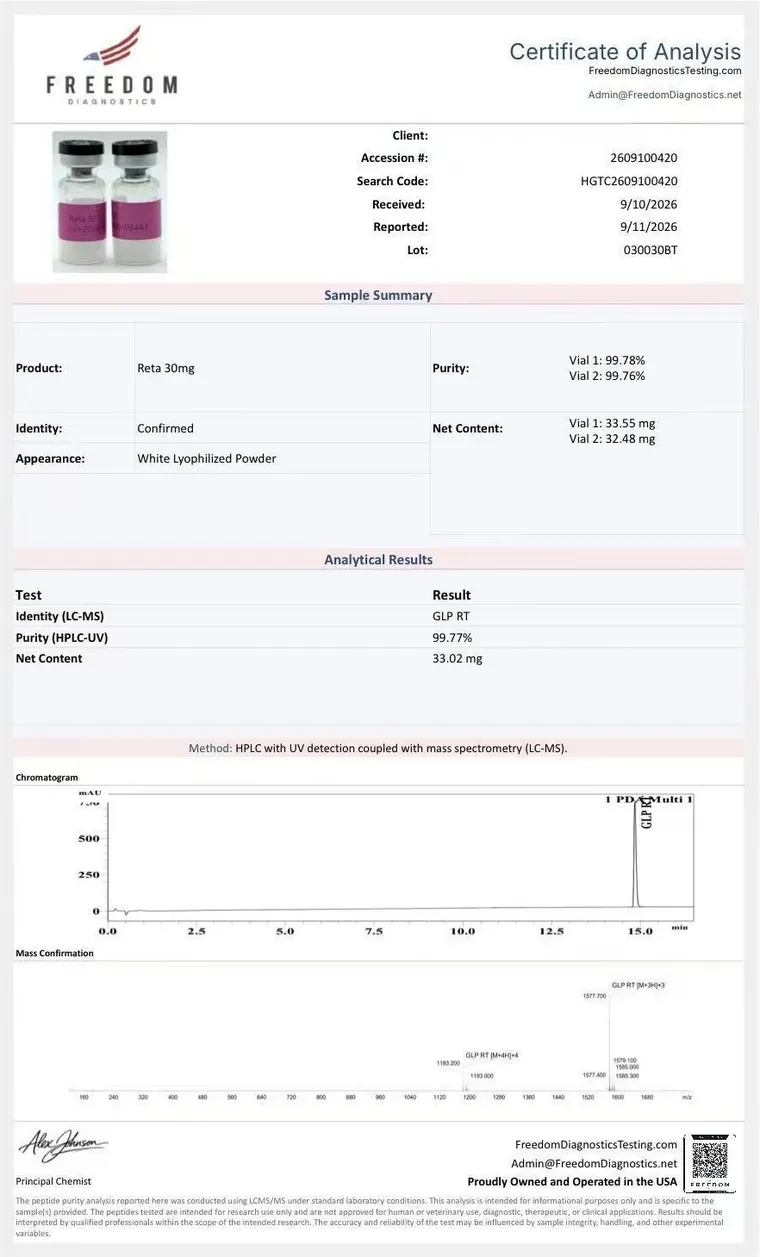
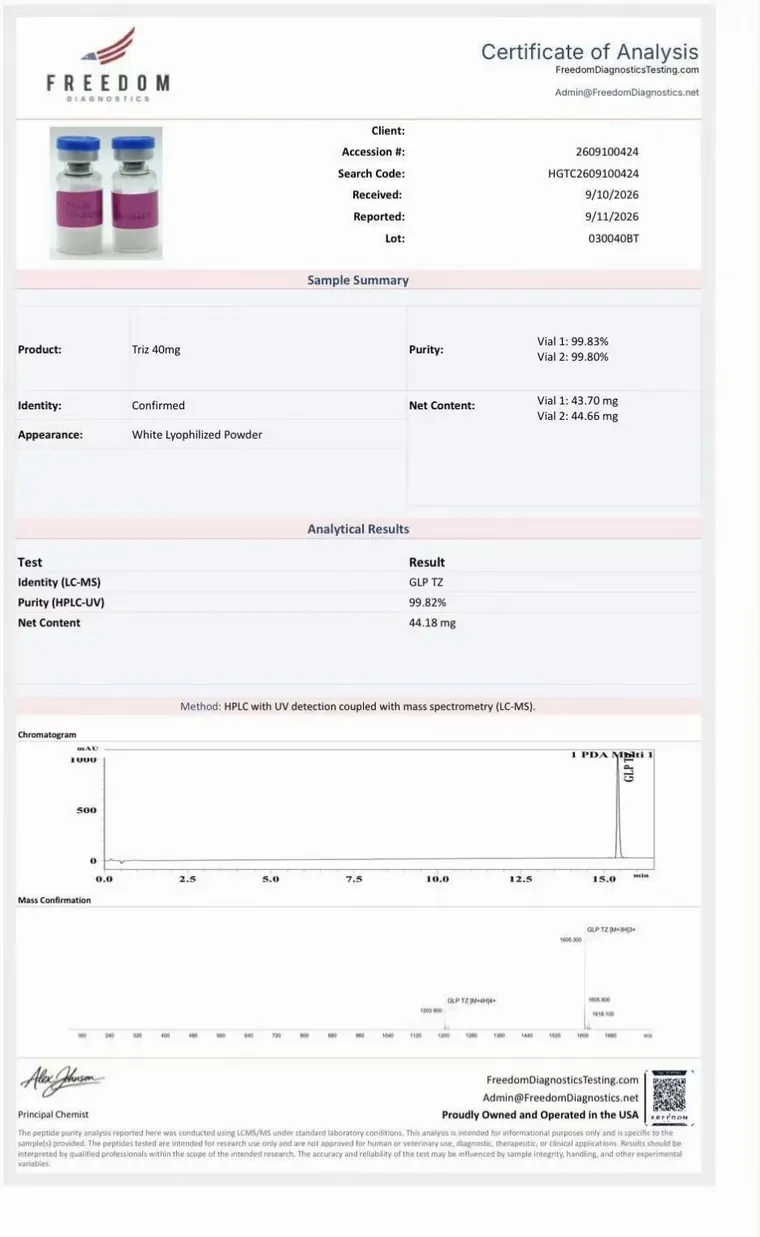
- Documentation replaces instructions. What a serious supplier gives you instead is a certificate of analysis: identity, purity, net content, lot number.
- Responsibility shifts to the buyer. How a research compound is handled, stored and used is decided by the laboratory that acquires it, within whatever rules apply where they operate.
How to tell a real supplier from a reseller
Ask three questions and the answer is usually obvious within a day:
- “Can I see the certificate for the lot in stock?” A factory sends it. A reseller forwards a screenshot from someone else, or a template with no lot number.
- “What is the net content, measured?” Fill weight is the number that separates a 10 mg vial from a 10 mg label. Anything between 10.5 and 11.5 mg is normal overfill; 7 mg is not.
- “Who tested it?” An independent laboratory with a name, a method and a signature — not “our own QC passed”.
The short version
Research peptides are short, precisely made amino-acid chains supplied as lyophilised powder for laboratory work. They are not medicines, they do not come with instructions, and the only thing standing between you and an unknown powder is documentation. Buy the documentation, not the label.
All compounds referenced in this article are supplied for laboratory research use only. Nothing here is medical advice, dosing guidance or a claim of therapeutic benefit.
← Back to Resources