“99.9% pure” is the most quoted and least understood number in the peptide trade. It is also, on its own, almost meaningless. Here is what the three numbers on a certificate of analysis actually measure.
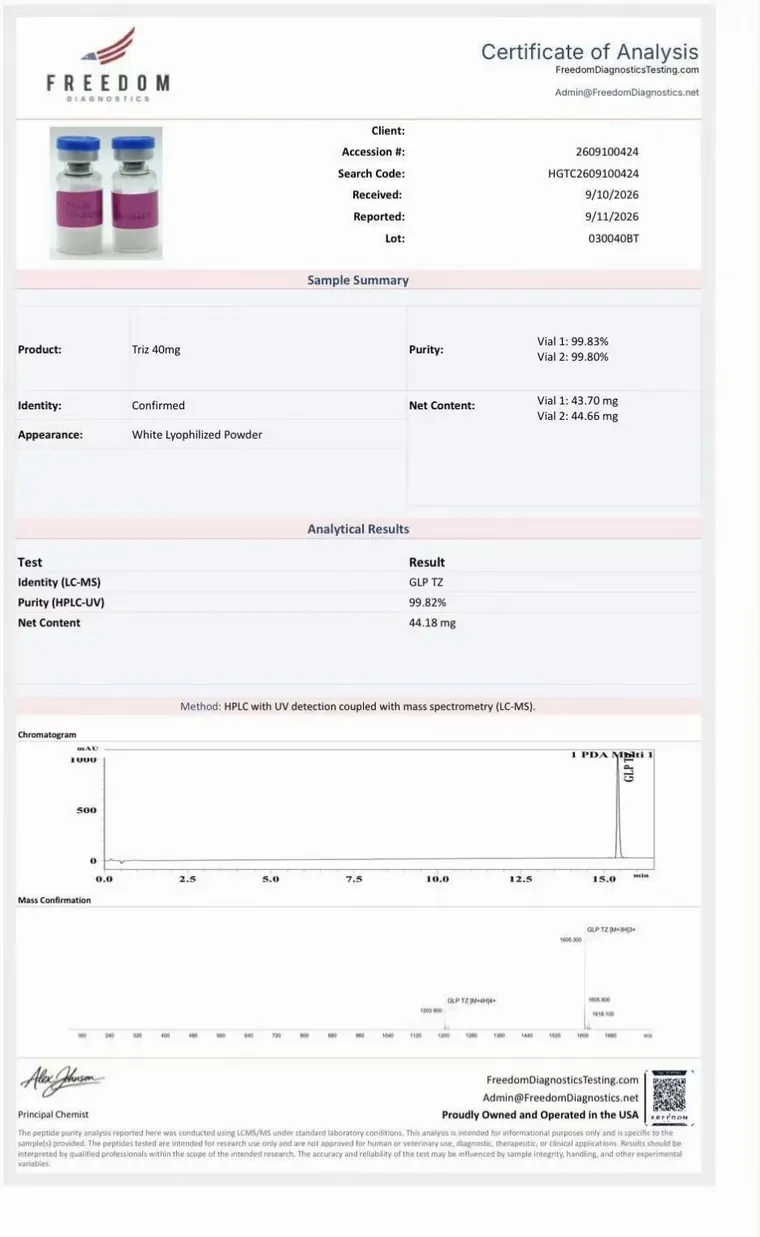
Number one: purity (HPLC-UV)
High-performance liquid chromatography separates the contents of a vial by how they interact with a column, then measures them with a UV detector — usually at 214 or 220 nm, where the peptide bond absorbs.
The result is expressed as area percentage: the area of the main peak divided by the total area of all peaks. A 99.3% figure means 99.3% of the UV-absorbing material came out in one peak.
What that tells you: the sample is dominated by a single species, and gross contaminants — truncated sequences, diastereomers, residual protecting groups — are limited.
What it does not tell you: how much peptide is in the vial. A 100% pure sample of nothing still reads 100%.
Number two: identity (mass spectrometry)
Mass spectrometry answers a different question: is the main peak the molecule on the label?
A peptide ionises into several charge states; the instrument reports the mass-to-charge ratios and calculates the neutral mass. A certificate that says “Identity (LC-MS): confirmed” with a spectrum showing peaks at, say, m/z 1183.5 [M+4H]⁴⁺ and 1577.7 [M+3H]³⁺ is showing its working. A certificate that says “confirmed” with no spectrum is asking you to take it on trust.
Mass also catches the classic substitution problem: a peptide one amino acid short has a different mass and will not match.
Number three: net content
Net content is the weight of peptide actually present, usually measured gravimetrically or by quantitative assay. This is the number that decides whether you were sold 10 mg or 7 mg.
Good suppliers overfill slightly, because filling a vial with exactly 10.00 mg of a fluffy lyophilised powder is not physically realistic. On our own published lots, a “10 mg” vial measured 11.06 mg, and a “30 mg” vial measured 33.02 mg — roughly 10% over, which is deliberate and disclosed.
Putting the three together
| Number | Question it answers | Typical good result |
|---|---|---|
| Purity (HPLC-UV) | Is one substance dominant? | 99.0% – 99.9% |
| Identity (LC-MS) | Is it the right substance? | Mass matches, spectrum supplied |
| Net content | How much is in the vial? | Label ±10%, over rather than under |
Three ways a purity number misleads
- Purity is relative to what the detector sees. Salts, counter-ions and water are largely invisible at 214 nm. A sample can be 99.5% pure by area and still be 20% water by weight — which is why residual moisture belongs on the certificate.
- Degradation lowers the main peak but can also hide. Deamidation may shift retention time slightly rather than creating an obvious new peak. Comparing the chromatogram against a reference standard is the honest way to judge.
- The number describes one vial. A certificate is lot-specific. A 99.9% result from a July batch says nothing about the vial in your hand unless the lot number matches.
What to ask for
- The certificate for the lot you are buying, not a sample.
- The chromatogram and the mass spectrum, not just the summary line.
- Net content in milligrams, with the method named.
- Water content, if you intend to store the vial for more than a few months.
If a supplier cannot produce those four things for the lot in stock, the percentage on the label is decoration.
All compounds referenced in this article are supplied for laboratory research use only. Nothing here is medical advice, dosing guidance or a claim of therapeutic benefit.
← Back to Resources