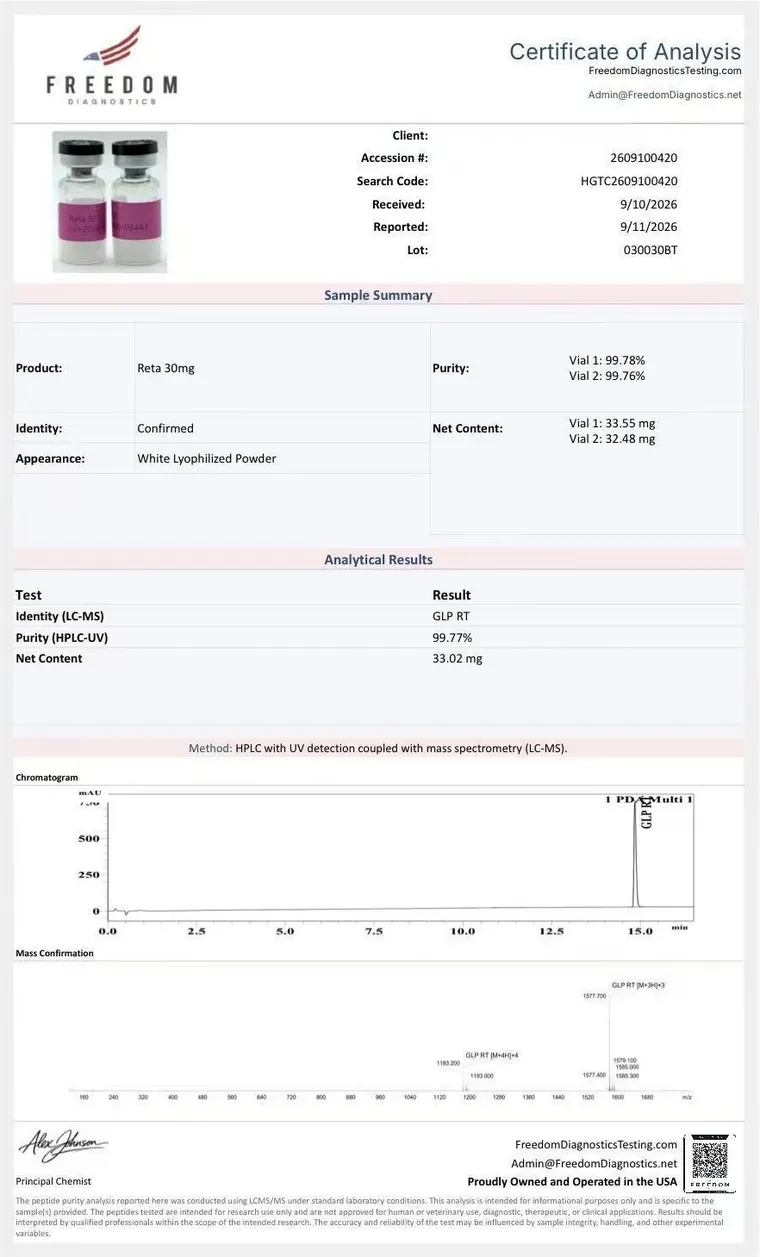
Most certificates of analysis look convincing. Very few survive being read line by line. Here is the order in which to read one.
1. Is it lot-specific?
The first thing to check is whether the document describes your vial. Look for a lot or batch number, and compare it with the label on the vial. A certificate without a lot number is a template; it proves the supplier once tested something similar.
An accession number — the laboratory's internal sample ID — is the second marker. It means the sample was received and logged by someone who is not the seller.
2. Who issued it?
An independent laboratory with a name, a website, an address and a named analyst is worth ten in-house “QC passed” stamps. Check that the lab's name on the certificate matches the lab's actual business — a logo is easy to copy.
3. What was measured, and how?
A complete certificate names the method next to each result: identity by LC-MS, purity by HPLC-UV at a stated wavelength, net content by assay or gravimetry. If the method column is missing, the result is an assertion rather than a measurement.
4. Do the numbers agree with the label?
Net content is where certificates and labels part company. A 10 mg label with 7 mg measured is not a rounding error; it is a different product. Slight overfill — 10 to 11 mg — is normal and should be disclosed.
5. Is the working shown?
A chromatogram with a single sharp main peak at a stated retention time, and a mass spectrum with labelled charge states, is what “we tested it” looks like. A summary table with no traces is what “we filled in a form” looks like.
Seven red flags
- No lot number, or a lot number that does not appear on the vial.
- The same certificate reused across products with only the product name changed.
- Purity quoted to two decimal places with no chromatogram.
- “Identity: confirmed” with no spectrum.
- A laboratory name you cannot find independently.
- Client name blanked out but an unrelated company's logo left visible.
- A test date older than the vial's fill date.
What a good certificate costs the supplier
Roughly 50 to 200 US dollars per lot at a third-party laboratory, plus the discipline of holding stock until results return. That is the real reason cheap suppliers skip it — not because testing is unavailable, but because it interrupts cash flow.
When you ask for a certificate and get one within an hour, with your lot number on it, you have learned something useful about that supplier.
All compounds referenced in this article are supplied for laboratory research use only. Nothing here is medical advice, dosing guidance or a claim of therapeutic benefit.
← Back to Resources